2026-04-06
Your Team Is Less Productive Because of This
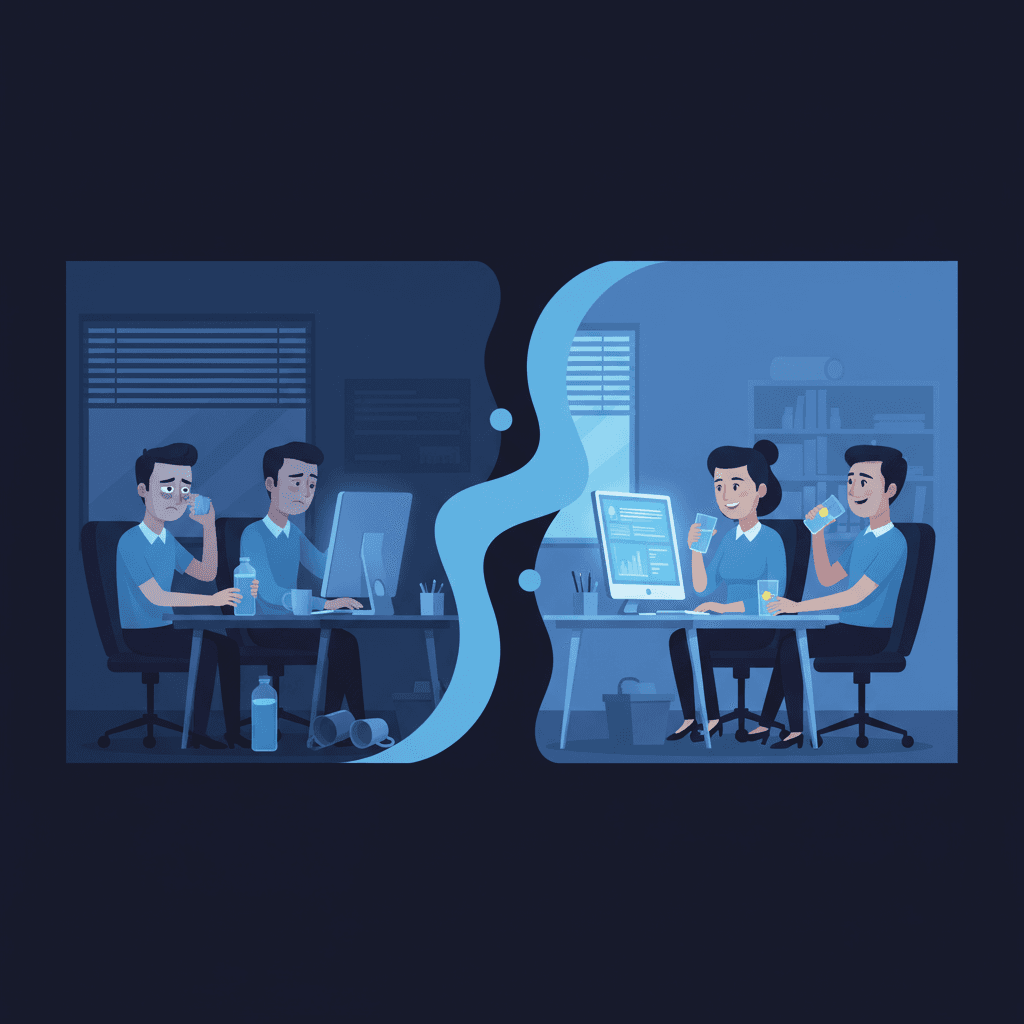
Your best employee just made three errors in a spreadsheet that should have been simple. Your project manager can't focus during the 2 PM meeting. Your sales team is dragging through afternoon calls.
The problem isn't motivation. It's not training. It's not even Monday.
It's dehydration.
The Problem Nobody Talks About
The research here is narrower than the internet claims, so let me give you what was actually measured.
Ganio and colleagues ran 26 young men through randomised, single-blind trials and published the results as Mild dehydration impairs cognitive performance and mood of men (British Journal of Nutrition, 2011). At roughly 1–2% of body mass lost, subjects made more errors on a visual vigilance task, were slower on working memory, and reported more fatigue and tension.
The companion study in women, Mild dehydration affects mood in healthy young women (The Journal of Nutrition, 2012), put 25 women through the same design at a mean 1.36% loss and found degraded mood, a higher perceived task difficulty, lower concentration and more headaches. It also reported that most aspects of cognitive performance were not affected — which is the honest shape of this literature and the reason I won't sell you a productivity percentage.
Note what these do not say: neither one measured office productivity, and neither produces a tidy percentage you can multiply by payroll. What they establish is that the deficit that degrades attention is small enough to arrive before you notice you're thirsty.
I sell water systems for offices, so I'm biased here. But that's the evidence as it stands.
Your Office Makes It Worse
Walk around your office right now. Count how many people have water at their desk. Real water. Not coffee. Not energy drinks.
Most offices I visit have the same setup: a water cooler in the corner that nobody refills, or cases of plastic bottles that run out by Wednesday.
People adapt. They drink less water because getting water is annoying.
And a deficit that small is easy to reach at a desk. You are not doing anything strenuous; you're just not drinking, for four hours, because the cooler is across the floor.
The Real Cost of Cheap Water
Most offices buy the cheapest water option. Plastic bottles. Basic coolers. "It's just water."
I'm not going to hand you a productivity percentage, because the studies above don't support one. What I'll say is narrower and I think more useful: attention and short-term memory are the things a mild deficit degrades first, and those are most of what knowledge work is.
There's a second bill attached. Gleick and Cooley's Energy implications of bottled water (Environmental Research Letters, 2009) put bottled water at 5.6–10.2 MJ per litre against about 0.005 for tap. So the setup that makes hydration inconvenient is also the expensive one.
What Actually Works
The solution isn't complicated. People need clean water at their workspace. Not across the room. Not in the kitchen. At their desk.
Good water systems put hydration where people work. Filtered. Clean. Easy access.
I've seen offices transform when hydration gets easier. People drink more. Focus improves. Afternoon crashes reduce.
The best part? When you solve the hydration problem, you solve the plastic waste problem too.
The 3 PM Test
Here's how to know if your office has a hydration problem: walk around at 3 PM.
Count yawns. Notice energy levels. Check how many people are reaching for their third coffee.
Then look at water consumption.
You'll see it. People are tired, unfocused, and reaching for a third coffee.
The fix is not complicated and it is not expensive. Put good water where people already are.
If your office is in Wisconsin: I cover the Madison area for Bottleless Nation. I'll test what's coming out of your tap and show you the numbers before you decide anything — see bottleless water coolers in Madison or get in touch.