2026-09-03
Bottled Water Is Food. Tap Water Is Infrastructure.
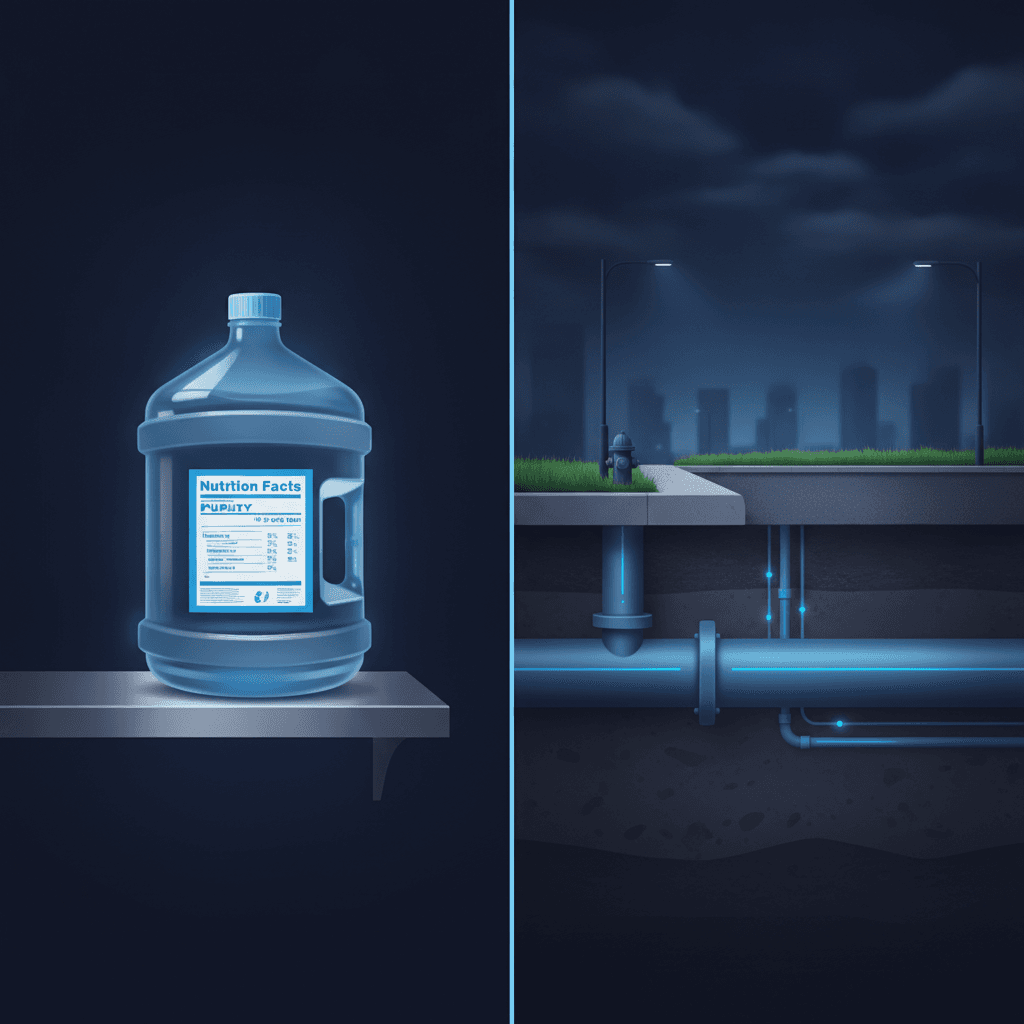
Here is something I end up explaining in a lot of breakroom conversations, and it usually comes as a surprise.
The bottled water in your office is regulated as a packaged food product by the FDA, under a standard of quality at 21 CFR 165.110 and plant rules at 21 CFR 129. The tap water coming into your building is regulated by the EPA under the Safe Drinking Water Act. Two agencies, two rulebooks, two sets of testing and reporting requirements.
Same liquid. Same purpose. Completely different oversight.
Upfront disclosure, as always: I sell bottleless water systems in the Madison area. I have an obvious bias here. So I'm going to stick to what the federal agencies actually publish and let you draw your own line.
What each framework actually asks
Under the Safe Drinking Water Act, EPA sets enforceable limits on what a public water system can deliver. That's how we got the first national PFAS drinking water standard in April 2024, which set enforceable limits for several PFAS compounds along with a Hazard Index approach for certain mixtures. Update, September 2026: in May 2026 EPA proposed rescinding the PFHxS, PFNA, GenX and mixture limits and proposed letting systems request until 2031 to meet the 4.0 ppt PFOA and PFOS limits, which stay as written; final action was still pending when I checked. The structural point holds either way: public systems get a number they have to hit, and the number is public.
EPA also runs occurrence monitoring on top of that. Under the Fifth Unregulated Contaminant Monitoring Rule, public water systems sampled for a set of PFAS compounds, and the results are published in a searchable dataset. Anyone can go look up their system.
Bottled water sits under a food framework instead. The law (section 410 of the FD&C Act) requires FDA's quality standards to be at least as protective as EPA's, and most of the limits match. What differs is the testing and reporting: a bottling plant must test finished product weekly for coliform and annually for chemical, physical and radiological contaminants, and it reports to FDA, not to you. A community water system has to mail or post an annual Consumer Confidence Report to every customer. That doesn't make bottled water unsafe. It makes it different, and it means the transparency you get is not the same kind of transparency.
Here's my practical point: if somebody in your office asks "what's in this water," you can answer that question for your tap much more directly than for the jugs. The public dataset exists. Go look.
Why this matters more with PFAS in the picture
PFAS are called forever chemicals because they break down very slowly. CDC's ATSDR notes that nearly all people in the U.S. have measurable PFAS in their blood, and its summary of the research associates higher exposure with increased cholesterol, changes in liver enzymes, lower antibody response to some vaccines, pregnancy-induced hypertension, small decreases in birth weight, and kidney and testicular cancer (for PFOA).
EPA has laid out a whole-of-agency roadmap to research, restrict, and remediate PFAS across drinking water, wastewater, air, and waste. NIEHS summarizes the research to date — possible links to altered metabolism, some cancers and reduced immune function — and flags the gaps that remain.
When a contaminant class is that persistent and that widespread, "which agency is watching this and what are they publishing" stops being a trivia question.
The part that's on you either way
None of this is optional for employers. 29 CFR 1910.141(b) requires potable drinking water in all places of employment, from dispensers that are designed, constructed and serviced so the water is kept sanitary. You have to provide water. The only question is how.
And the delivery model has a tail. EPA's own materials and waste data shows that only 8.7% of plastics generated in the U.S. were recycled in 2018, with PET bottles and jars at 29.1% — better than plastics overall, still well under a third. Containers and packaging make up the largest single category of municipal solid waste generated.
What I actually think
Most offices never make a water decision. They inherit one. Somebody ordered jugs years ago and the standing order never stopped.
I'm not here to tell you bottled is bad and point-of-use is good. I'm here to say you're already making a regulatory choice without knowing it, and one of those two paths has a public database you can search this afternoon.
Start there. Look up your building's system in the UCMR data. Whatever you decide after that, at least you'll have decided.