2026-09-04
Your Breakroom Is Sized for a Building That Doesn't Exist Anymore
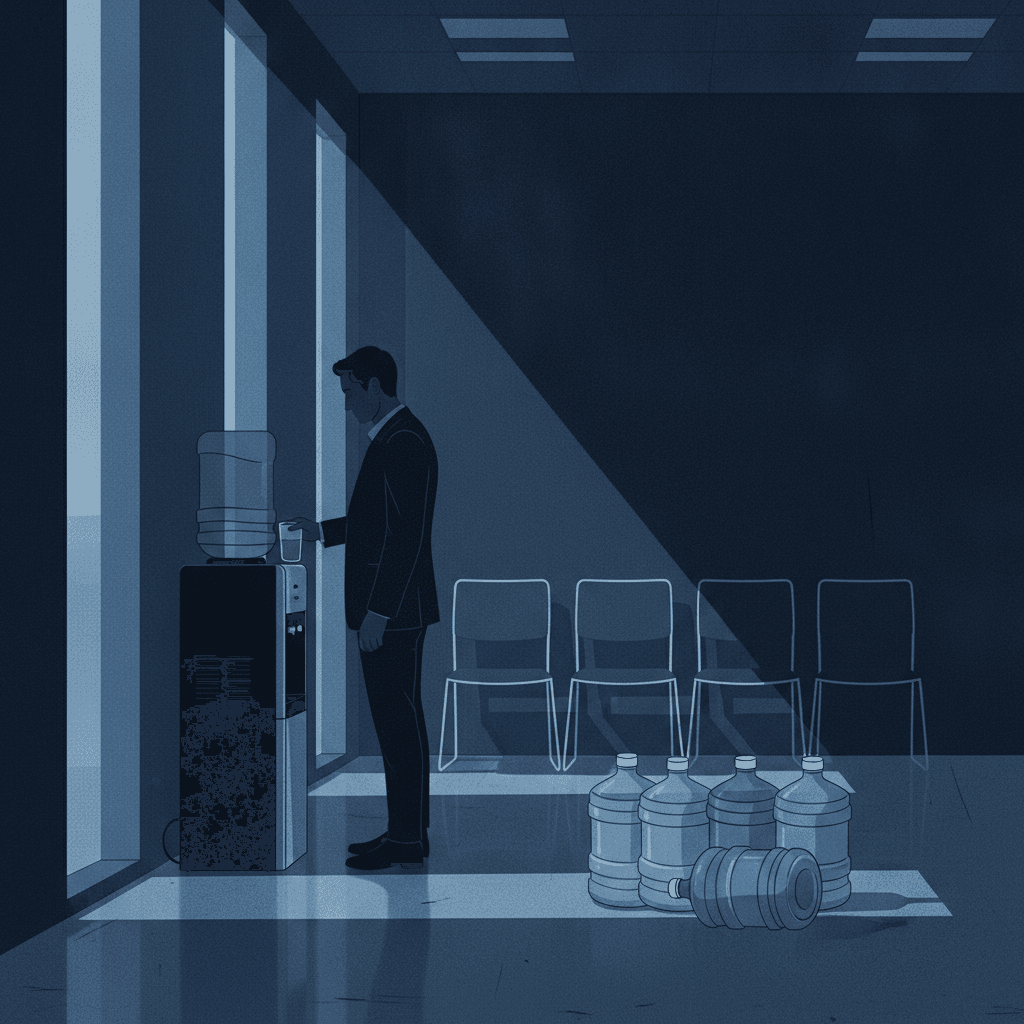
Walk into a lot of office breakrooms right now and you'll see the same thing: a stack of five-gallon bottles against the wall, most of them untouched, delivered on a schedule somebody set up years ago.
The delivery cadence didn't change. The building did.
I sell bottleless water systems for a living, so read this knowing where I sit. But this pattern isn't a sales pitch. It's just what happens when a recurring contract outlives the assumptions it was built on.
The headcount moved and the contract didn't
Gallup's hybrid work tracking shows that most remote-capable U.S. employees now work hybrid or fully remote rather than fully on-site: as of May 2026, 52% hybrid, 26% exclusively remote, 22% on-site. That's not a temporary blip anymore. It's the baseline.
So a building that used to run at full occupancy five days a week now runs at some fraction of that, and the fraction moves day to day. Monday looks nothing like Wednesday.
Almost nobody re-ran the breakroom math after that shift. Coffee orders, snack orders, water delivery — a lot of it is still calibrated to the pre-pandemic version of the office. On light days you're storing product. On heavy days you run out. Same invoice either way.
The floor didn't move, though
Here's what does not scale down with occupancy: the legal requirement.
Federal law says employers have to provide potable water in the workplace for drinking, and any non-potable outlet has to be posted so nobody drinks from it. That's 29 CFR 1910.141(b). It applies whether four people show up or four hundred.
So the answer to a half-full building isn't "cut the water." It's "stop paying for volume and start paying for availability." Those are different products. A delivery contract sells you gallons. A plumbed-in system sells you a working tap.
When occupancy is unpredictable, availability is the thing you actually need.
The waste gets uglier when volume drops
The environmental argument against delivered bottles is already rough. EPA's materials and waste data show that only a small share of plastics get recycled overall, with PET bottles and jars faring better but still ending up well short of a majority.
Now layer in a hybrid building. You're not just moving plastic around — you're moving plastic around for people who aren't there. Trucks running a route to drop bottles nobody drinks that week. That's the part I'd flag if I were writing a sustainability report, and it's the part that usually doesn't make it in.
What actually gets used
The other half of this is that people who do come in are choosing to be there. They drove in. They want the day to be worth it.
CDC's Workplace Health Model lists environmental supports alongside programs and policies as the things a workplace health effort is built from. Not a poster campaign. The stuff that's physically in the room.
And the target isn't small. The National Academies' reference intake for total water, as summarized by Harvard, is a few liters a day for most adults across all beverages and food. A warm cooler in the corner with two bottles left isn't moving anybody toward that.
If you go the bottleless route, check the filtration is independently certified — NSF publishes a searchable listing of point-of-use treatment units tested to NSF/ANSI standards. Ask for the listing number. Any honest rep will have it.
The audit nobody schedules
Companies re-negotiate their lease when the footprint changes. They re-negotiate cleaning. They almost never look at the breakroom line items, because each one is too small to trigger a review and too automatic to notice.
That's the whole trick of a recurring contract. It survives on not being looked at.
Pull last quarter's water invoices and put them next to your badge-swipe data. Whatever you find, you'll at least know what you're buying.