2026-04-12
Your Office Burns 2,000X More Energy Than It Needs To
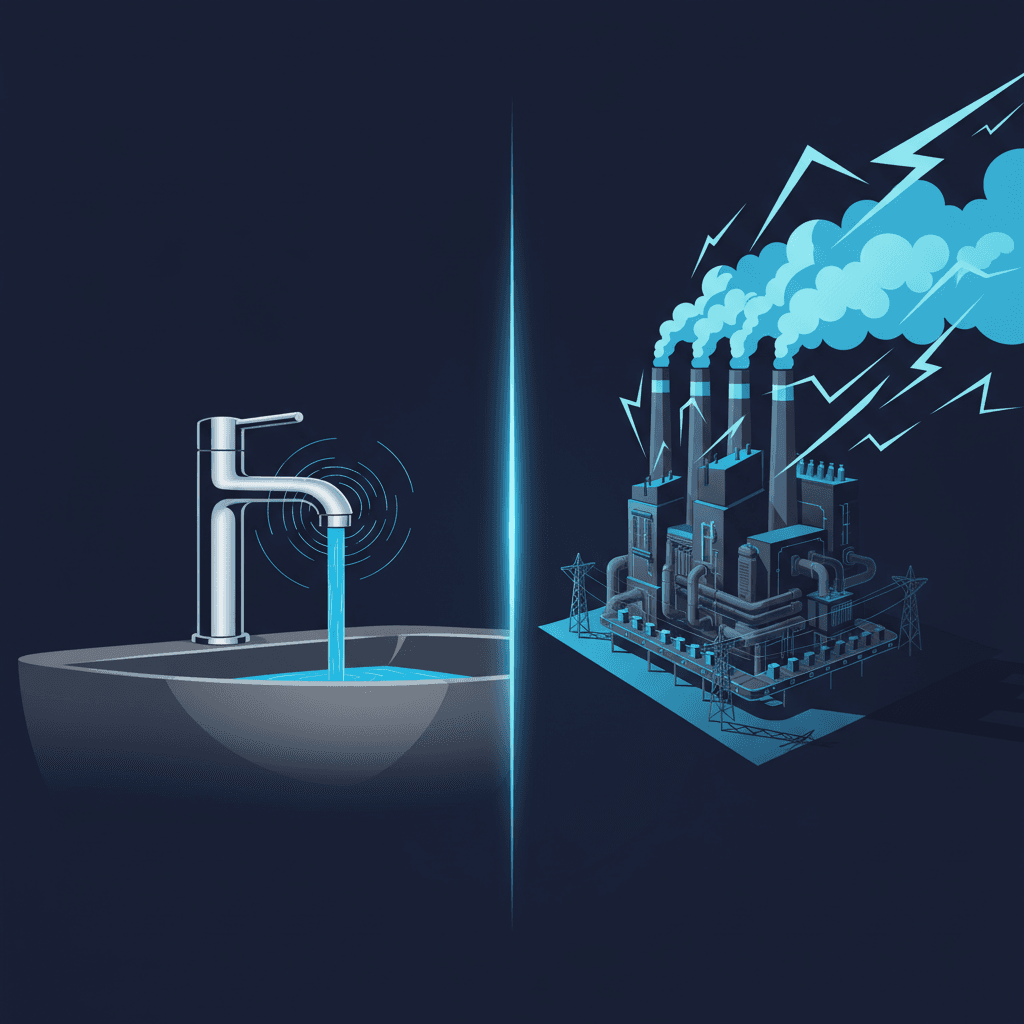
Your office just spent a lot more energy than it needed to.
Peter Gleick and Heather Cooley put a number on this in Energy implications of bottled water (Environmental Research Letters, 2009). Their finding, in their words: producing bottled water requires between 5.6 and 10.2 MJ per litre — "as much as 2000 times the energy cost of producing tap water," which they put at about 0.005 MJ per litre for treatment and distribution.
I sell water systems, so yes, I have skin in this game. But that number isn't mine.
The Hidden Energy Cost of Your Breakroom
Think about your last bottled water order. Fifty cases? A hundred? Each bottle went through manufacturing, filling, capping, labeling, packaging, shipping, and refrigeration. All to deliver something that flows from your tap.
Gleick and Cooley found that for water shipped a short distance, most of that energy goes into making the plastic bottle itself. Ship it far enough and transport matches the bottle. The stages stack up:
- Manufacturing the plastic bottle
- Transporting empty bottles to the filling plant
- Processing and bottling the water
- Shipping filled bottles to distributors
- Trucking to your office
- Storing in refrigerated coolers
Compare that to tap water: it flows through existing infrastructure to your building. Done.
Your Office Is Part of the Problem
The same paper estimated that America's 33 billion litres of bottled water in 2007 took the energy equivalent of 32 to 54 million barrels of oil to produce — which they note is about a third of a per cent of total US primary energy consumption. Bottled water volume has grown since — the International Bottled Water Association reported 16.4 billion gallons consumed in the US in 2024.
Here's what kills me: most offices don't even track this cost. You see the invoice for bottled water delivery. You don't see the hidden energy bill that everyone pays through environmental impact.
The Math on One Office
Say your office goes through 20 cases a month. That's roughly 480 half-litre bottles, or 240 litres. At Gleick and Cooley's midpoint of about 8 MJ per litre, that's around 1,900 MJ a month. The same 240 litres from a tap: about 1.2 MJ.
That difference has to come from somewhere. Power plants. Fossil fuels. Carbon emissions. All for water that's often just filtered tap water anyway.
Why This Matters Now
Energy costs aren't going down. Carbon regulations aren't getting lighter. Your company's sustainability commitments aren't getting easier to meet.
Yet most offices haven't done the basic math on their water energy footprint. They track printer paper usage but ignore the energy bomb in their breakroom.
The Alternative Is Right There
Install a point-of-use water system. Connect it to your existing water line. Filter what you need, when you need it. No trucks. No plastic manufacturing. No massive energy penalty.
I've seen the resistance: "But bottled water is convenient." "What if the filter breaks?" "Our employees expect bottles."
Fair points. But convenience that costs three orders of magnitude more energy isn't really convenient. It's waste with good marketing.
Your office can do better. The math says so.
If your office is in Wisconsin: I cover the Madison area for Bottleless Nation. I'll test what's coming out of your tap and show you the numbers before you decide anything — see bottleless water coolers in Madison or get in touch.